
Clinton County Recent Arrest Sources
The Clinton County Sheriff's Office comes first. Its "Who's in Jail" link opens the CentralSquare inmate portal. It shows current custody rather than everyone arrested in Clinton County today. A fresh booking needs time to process. Someone released fast may never show up at all. The county offers no same-day feed or multi-day booking archive. The roster is not an arrest count.
Each source answers a different question. The portal tells you who is in jail right now. Clinton Police keeps a daily information log you can request. Iowa Courts Online follows a case once it is filed. Unofficial indexes can help pin down a date, but they often copy stale data. For same-day searching, use the Daily Arrest Report. For a date range, turn to the Weekly Arrest Log.
| Window | Best source | What it means |
|---|---|---|
| Current | CentralSquare roster | People shown in county custody when checked |
| Same day | Roster plus city police log request | Newly observed records, not a complete 24-hour total |
| Several days | Existing logs and booking records by date | Records requested from the proper custodian |
| Case outcome | Iowa Courts Online | Docket events and later disposition |
Arrested Overnight in Clinton County
Checking on an overnight arrest in Clinton County? Start with CentralSquare and write down the time of your search. The portal promises no update schedule. A missing name does not mean no arrest happened. Next, call the agency that made the arrest. Ask for its daily log, arrest report, or booking record. Clinton Police has a set daily-log process. DeWitt and Camanche list contact routes but no matching online table. The Daily Arrest Report walks through this short window. The VINELink Inmate Check helps you track later custody changes for one person.
Search the Clinton County Roster
The CentralSquare portal is now the county's main public roster, replacing older county links. The sheriff FAQ still points to a legacy Marshall/Zuercher destination. So use the live sheriff home page link instead. The app builds its pages on the fly. Search fields and result labels shift without notice, and the county publishes no update cadence. Treat anything you see as a moment-in-time view. Call the jail at 563-242-9211 for urgent custody questions.
| Possible field | How to use it | Limit |
|---|---|---|
| Name | Begin a current-custody match | A shared name does not prove identity |
| Booking date | Distinguish jail intake from arrest time | May not show the alleged offense time |
| Charge and bond | Read the booking charge and pretrial terms | Both can change in court |
| Agency or booking number | Cross-reference a records request | Availability depends on the live record |
| Photo | Identify a booking image when supplied | No county policy promises every photo |
Open the official roster and search the narrowest name you can trust. Compare any booking details it returns. Note the time you checked. A missing person means you should call the jail or the arresting police department and request the exact record series. The sheriff's office offers no booking app. The official roster screen displays the county's current public custody interface.
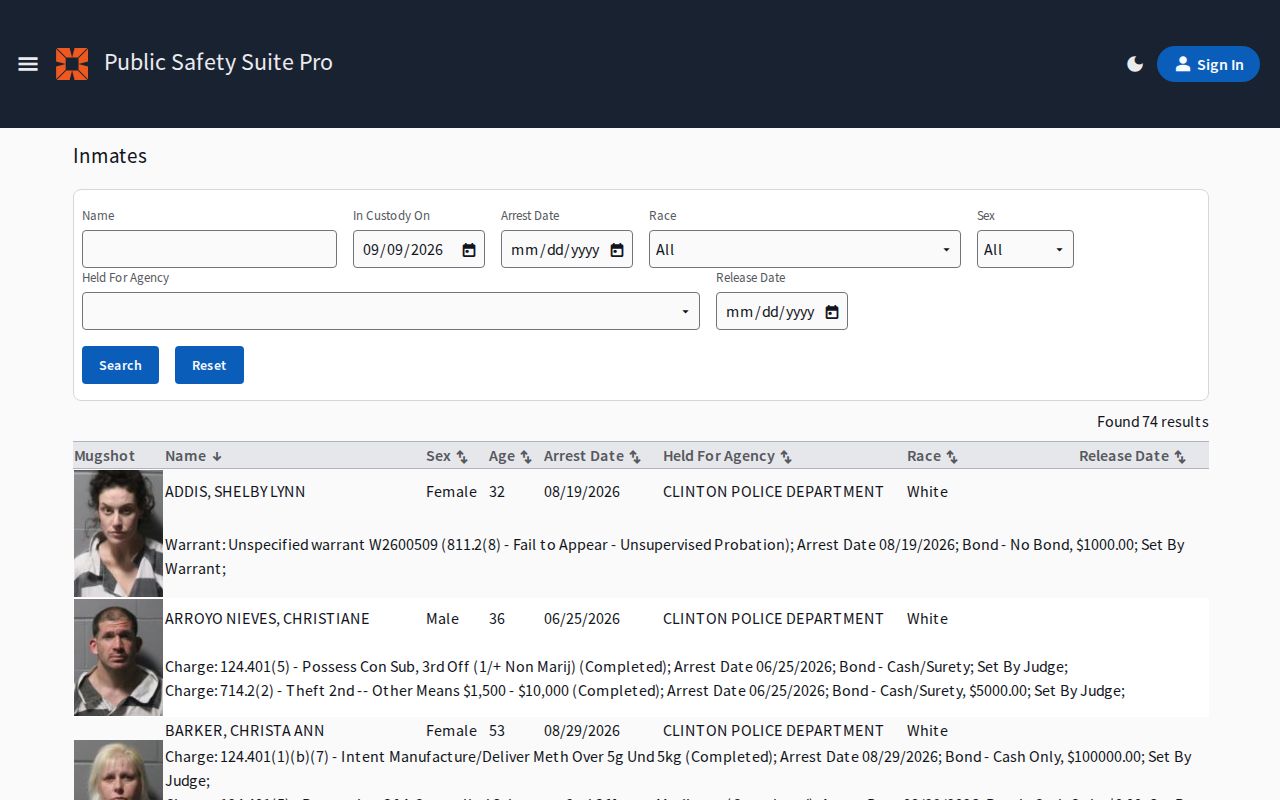
This capture documents the source to use, without reproducing a gallery of people.
Where Clinton County Arrests Appear
Official sources lead the way because each one covers a single layer of the record. The sheriff roster handles current county custody. A city police log can preserve an event after release. Iowa Courts Online carries the court trail. Iowa DOC covers state custody or supervision after sentencing. News stories and commercial aggregators can point you toward a case. They never replace the records themselves.
| Channel | Status | Coverage |
|---|---|---|
| County CentralSquare portal | Official | Current county custody |
| Police records divisions | Official | Existing arrest reports or logs |
| Iowa Courts Online | Official | Case docket and disposition |
| Iowa DPS Arrest Distribution | Official | Aggregate statistics, not named bookings |
| Commercial aggregators | Unofficial | Copied entries that may be incomplete or stale |
The Iowa DPS statistics interface separates date, agency, municipality, and offense filters.
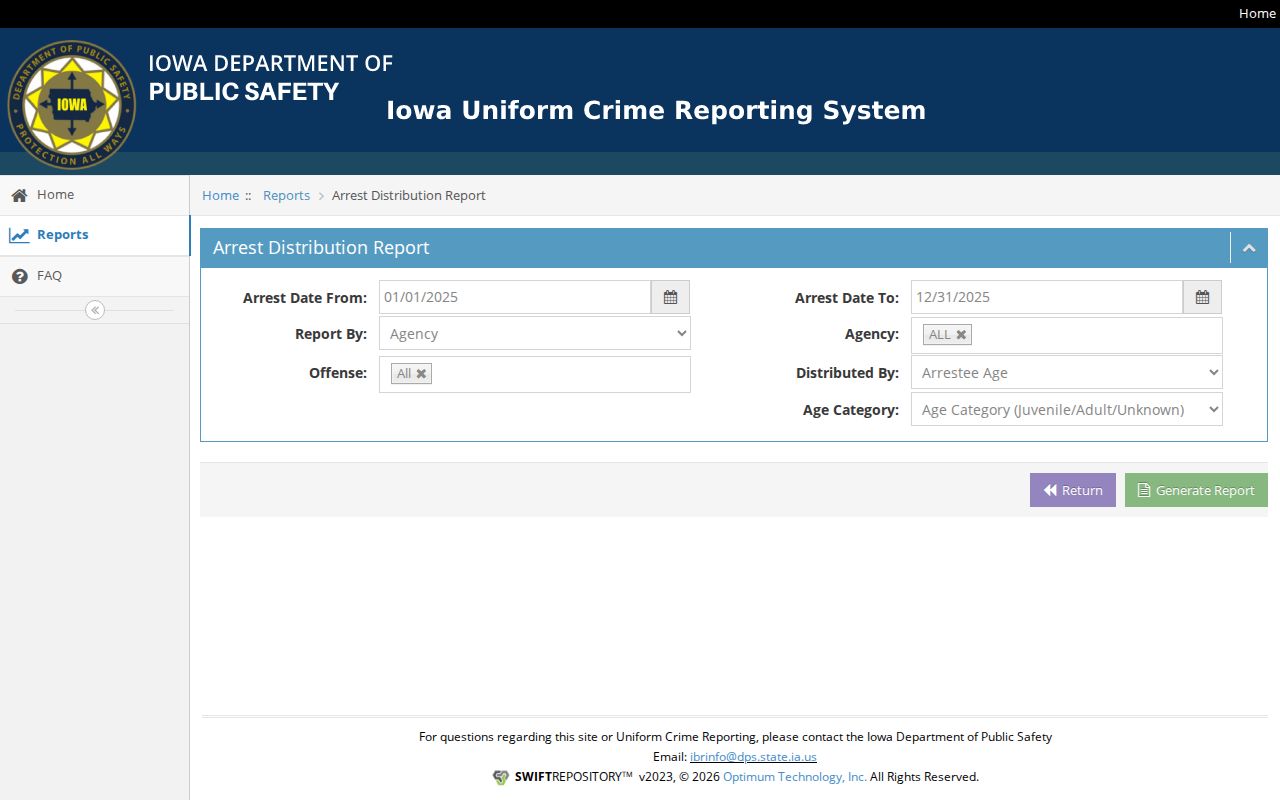
It is useful for trends, but it does not identify who was booked.
Recent Arrests by City
City records fill the gaps a custody roster leaves behind. Clinton Recent Arrests covers the Police Records Division and its request-only daily log. DeWitt Recent Arrests ties DeWitt Police records to county booking lookup. It also pulls in official yearly statistics. Camanche Recent Arrests explains the police contact, prisoner transport, and county roster. Check the court docket too.
What Clinton County Arrest Records Show
An arrest, a booking, custody, a charge, and a disposition are five separate events. The police report records the arrest itself. The booking sheet documents jail intake. The live roster says who is in custody, and the court docket tracks the charge. Keep the source and its timestamp with every detail.
| Field | Meaning |
|---|---|
| Name and identifying data | Helps distinguish records; a name alone is not proof of identity |
| Arrest date, place, agency | Describes the police event and jurisdiction |
| Booking date and number | Marks jail intake and provides a cross-system key |
| Charge and statute | Records the charge as booked, not guilt |
| Bond and custody location | Shows a pretrial condition and the recorded facility |
| Release status | May reflect bond, transfer, time served, or another reason |
| Court case and disposition | Connects the charge to its later legal result |
Dates deserve a careful eye. Arrest time marks the police event. Booking time marks jail intake. Publication time records when a portal displayed the entry. Release time can reflect bond, transfer, served time, or a cleared hold. An alleged offense date can predate them all. If an unofficial page shows a single date, do not guess which event it means; request the original report or booking sheet and keep the source timestamp with it.
Jurisdiction shifts too. The arresting officer may come from Clinton Police, DeWitt Police, Camanche Police, the county sheriff, Iowa DPS, or another agency. The person can still be booked at the county jail. A case may be filed in a different county if venue changes, and a county booking can later pick up a state or federal hold. Keep agency, booking location, offense location, and court venue as separate fields.
Clinton County Mugshots and Arrest Photos
Clinton County has no published rule promising a booking photo on every CentralSquare entry, and no policy says how long an image stays visible. A blank photo spot means little. It does not mean no photo was taken. The Sheriff's Records Division handles requests for a specific booking photograph. Name the person and the booking date. If an image is withheld, ask for the legal basis. Iowa Code Chapter 22 opens many records to the public while still protecting designated confidential material, including parts of active investigations.
The Iowa Department of Corrections offender search covers a different layer, state custody or supervision, and it may carry an offender image. It is not a county mugshot archive. Aggregator sites copy booking photos. Busted Newspaper, RecentlyBooked, Iowa Arrests.org, and Mugshots Zone publish unofficial copied images, and those pages can be stale, incomplete, or wrong. A compressed copy proves little.
Photo access differs from record access. CentralSquare may show an image on a live profile. The sheriff publishes no universal display rule, exclusion policy, or post-release duration for booking photos. Statewide VINE material says some jail photos appear when a facility supplies them. That broad statement is not a Clinton County guarantee. Identity questions, corrections, and legal matters call for the exact booking image, so ask the custodian for it and its public status rather than an aggregator copy.
An Iowa DOC photograph documents a different stage. DOC results concern state imprisonment or supervision. That stage generally follows a court disposition. A county booking image comes from local intake near the start of a case. A person in the DOC system may have no current tie to the Clinton County jail. A recent county arrestee may never reach state custody. These images and databases do not substitute for each other.
Request a Clinton County Arrest Record
The Sheriff's Records page prices incident reports at $2 and accident reports at $4. No booking-photo fee or turnaround is published. Clinton Police sends record requests to its Records Division. It does not use the city's general portal. DeWitt or Camanche records belong with the department that created them.
- Identify the person, date range, arresting agency, and any case or booking number.
- Ask for existing series by name: booking sheet, jail calendar, arrest report, release record, daily information log, or booking photograph.
- Request an estimate before search, review, copy, or media charges exceed the standard published amount.
- If material is withheld, ask for the legal basis and all reasonably separable public portions.
- Use Iowa Courts Online to verify the later disposition rather than treating the booking charge as final.
Clinton Police posts more detailed copy charges than the sheriff. Black-and-white pages run $0.15 each, color pages $0.25, and oversized pages $0.50, with a fax adding $1 plus staff or attorney-review rates where applicable. None of that is a universal sheriff booking-photo fee. DeWitt and Camanche publish no booking-log form, photo fee, or fixed turnaround. Ask for an estimate first.
A good date-range request seeks an existing output rather than a new analysis built by staff. Stick to named record types. Terms like "jail calendar," "booking log," "booking sheet," "daily information log," "release record," and "arrest report" each point to a known series. A requested series may not exist. Ask the office to say so plainly. If a record was destroyed, ask which approved schedule authorized the destruction. When material is withheld, request the specific legal basis and any segregable public portion.
The Clinton records instructions and fee page routes police requests to the proper division.
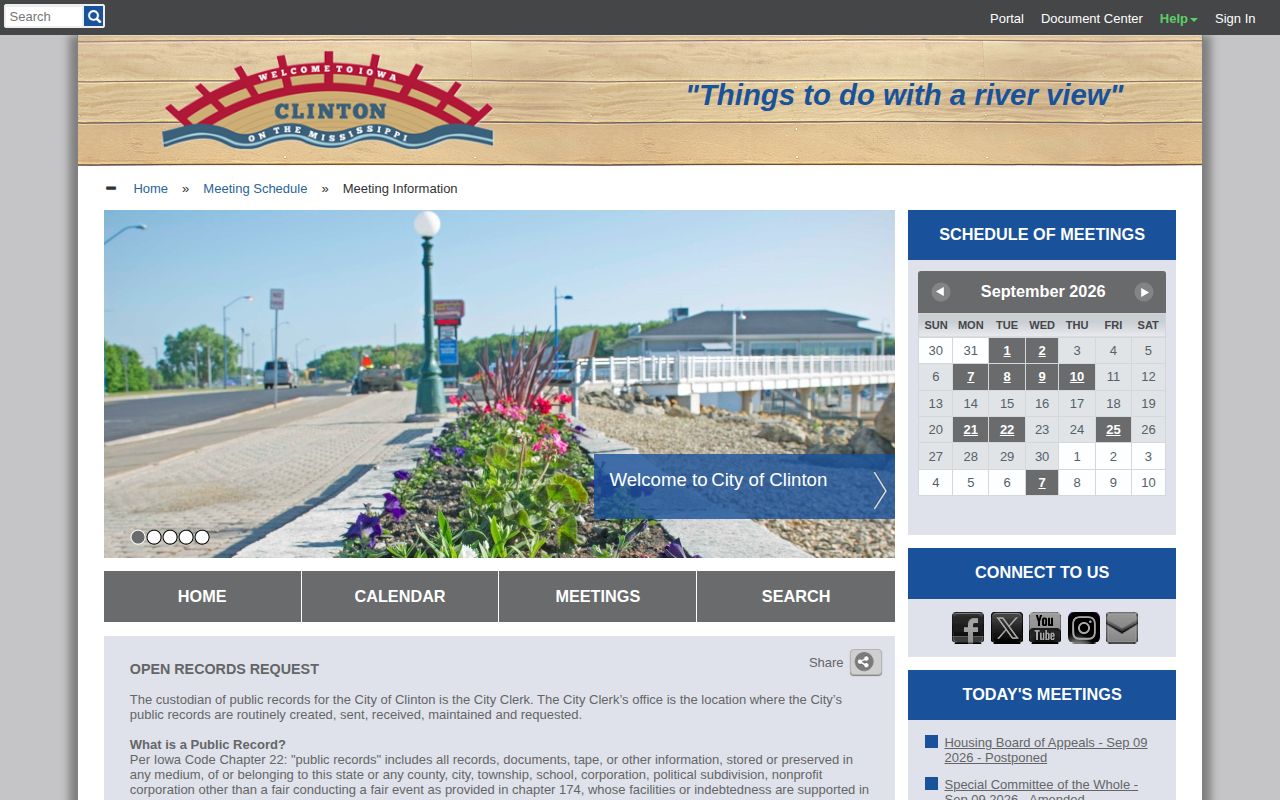
The capture helps distinguish the police request path from the city's general portal.
Iowa Law and Arrest Corrections
Iowa Code section 22.7 treats current and prior arrest information as public while keeping specific confidential material protected. Juvenile, investigative, medical, and safety limits can affect release. The Iowa Public Information Board notes that Chapter 22 allows inspection and copying but sets no single production deadline for every request. A reasonable response is not always immediate production.
Fixing a record happens in layers. Start with the originating agency. Ask it to correct inaccurate data. For eligible cases, the Iowa Judicial Branch expungement forms under Chapter 901C offer court relief. RecentlyBooked offers a no-charge review policy for certain dismissed, sealed, expunged, juvenile, duplicate, wrong-person, or outdated entries. Mugshots Zone has its own document-based form. Neither site process changes the official record.
The Google outdated-content process applies only after a source changes or disappears.
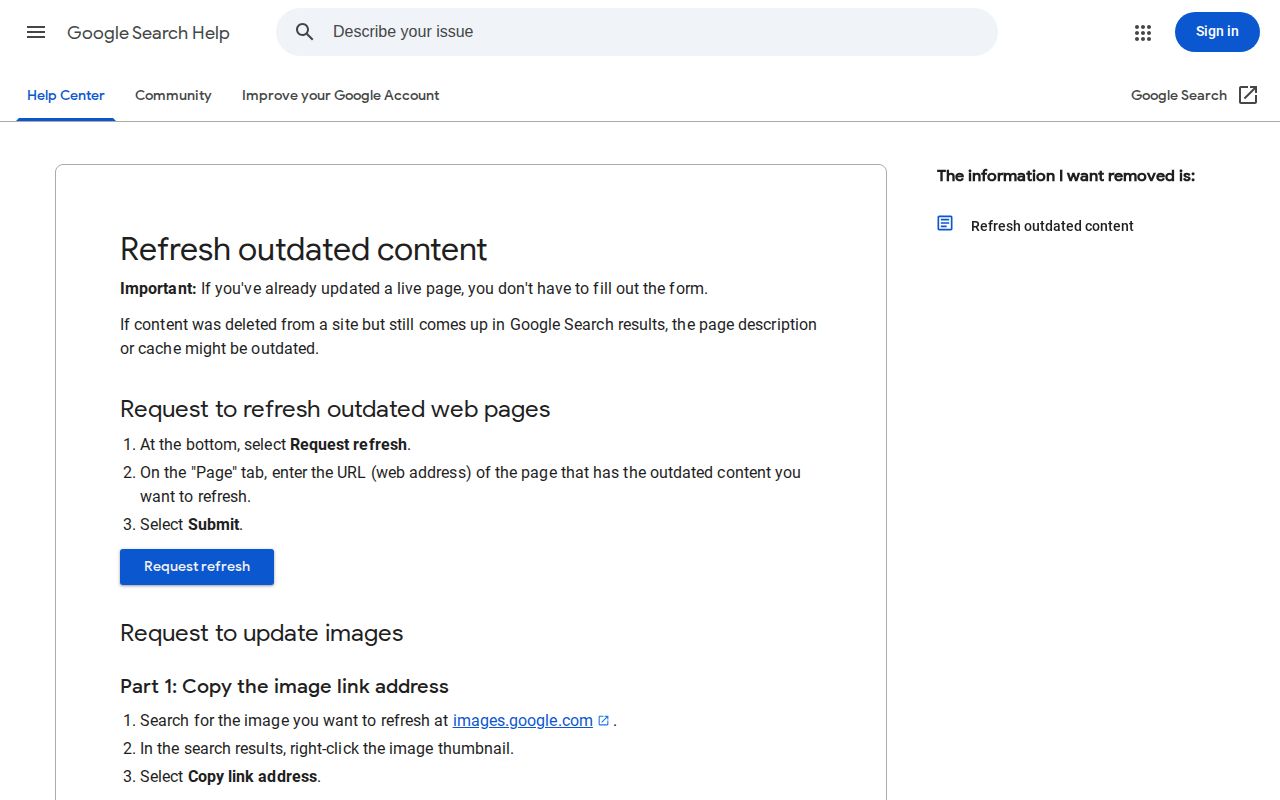
Refreshing a search result is one thing. Removing a live government page or a third-party site is another. Corrections take source-by-source work, and Iowa law shapes what stays and what goes.
Retention is equally piecemeal. Iowa jail rule 201-50.22 sets a two-year baseline for certain listed records. Jail calendars and visitor registration are on that list. That is not a blanket two-year promise for every Clinton County booking sheet or photo. The State Records Commission manual mostly covers state-agency schedules. For older county newspapers or named record series, Historical Society collections can help. The sheriff's office itself publishes no public mugshot collection. So ask the specific question. Was the exact record retained, destroyed under an approved schedule, transferred, archived, redacted, or withheld?
Timing works differently too. Iowa Public Information Board guidance separates an agency's duty to respond promptly from actual production time. That split matters. Chapter 22 sets no single turnaround for every record. A custodian may need to locate documents, review confidential portions, estimate charges, or clarify scope. A narrow request usually beats a county-wide demand. Name the person, agency, record series, and date range. Keep copies of the request, estimates, responses, and any cited exemption.
Third-party publishers run their own correction processes. RecentlyBooked wants the record URL, name, arrest date, jurisdiction, reason, and supporting documents. The review is free. Mugshots Zone asks for the source URL and contact details. Its form also wants a reason and legal documents. Acceptable reasons include dismissal, sealing, expungement, or wrong identity. Its form states a five-to-ten-day review period. Neither process can seal a court case or change a sheriff record. They also cannot guarantee removal from another site. No paid-removal service is recommended here.
Clinton County Arrest Warrants
The Clinton County sheriff's site offers no public active-warrant database or most-wanted gallery. Crime Stoppers is a tip program, not a warrant list. A roster entry or unofficial page might mention a warrant or hold. Yet it cannot confirm county-wide active status for someone not in custody. Search Iowa Courts Online for case entries. Then confirm with the sheriff, clerk, or an attorney. Ask for the warrant number, issuing court, date, recall status, and bond. Never approach or try to detain someone because an online label says so. Tips go through Clinton County Crime Stoppers. Call 911 for immediate danger.
Crime Stoppers pairs the county sheriff with the Clinton, DeWitt, and Camanche police departments. It takes anonymous tips. The program states rewards can reach $1,000 when information leads to an arrest. A tip still is not evidence. The program simply passes information to law enforcement. A person-specific warrant concern belongs with the issuing court, the sheriff, or an attorney.
After a Clinton County Arrest
Booking is only the first step. Court proceedings may follow. Those steps can include an initial appearance, bond review, arraignment, plea, trial, dismissal, judgment, or sentencing. A disposition is the court's recorded outcome. The free Iowa Courts Online docket can be searched by name and Clinton County. Public case documents sit on courthouse terminals where permitted. Match the filing date and case number, since charge wording may change. Delays between a jail event and a court filing are common.
The official court search landing page identifies the public docket route.
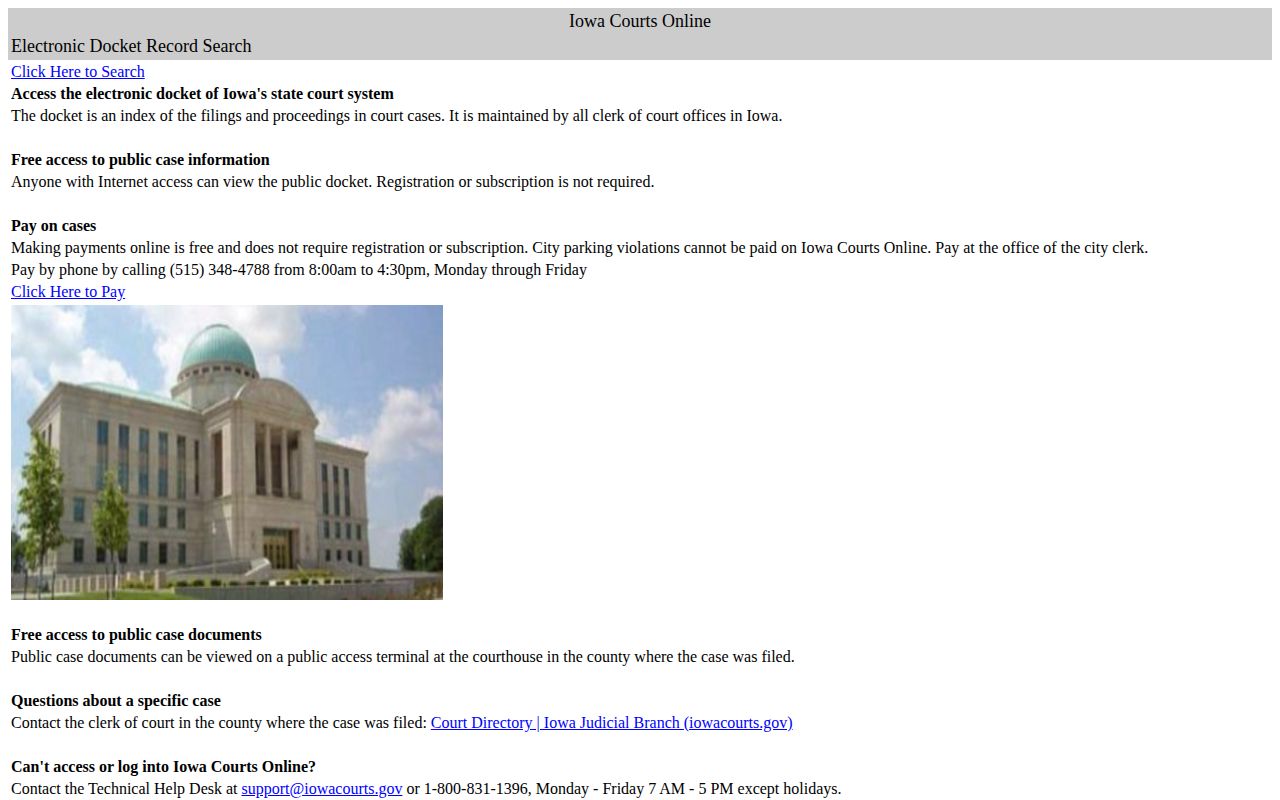
A booking entry leaves the story unfinished. The court record finishes it.
Search with a full name, Clinton County, an approximate filing date, case type, and the charge wording from the booking source. Open the case number and read the full sequence. Do not rely on a search-result headline. An arraignment is where charges are formally addressed. A preliminary hearing tests whether a case should proceed. A plea, dismissal, acquittal, deferred judgment, or judgment can change what may accurately be said about the original arrest record. When the online index lacks a public document, a courthouse terminal may provide access allowed by court rules.
State and Federal Custody Records
Custody splits into layers, and each layer answers to a different office. A person serving an Iowa prison sentence falls under the Iowa Department of Corrections. The county jail roster does not cover that person. The Bureau of Prisons Inmate Locator handles federal inmates going back to 1982. It is not a booking-photo archive for Clinton County arrests. Immigration detention has its own tool, the ICE detainee locator. Federal pretrial detainees are sometimes boarded in local jails under U.S. Marshals contracts. Where a person sits physically does not tell you which system holds the case.
The BOP locator works by name or register number. A result can carry the register number, age, race, sex, release date, and holding location. BOP cautions that release dates shift after sentence review. ICE offers two paths. One is an A-number with country of birth; the other is an exact biographical match. It will not search anyone under 18. An empty result from either system means only that its own layer holds no record. It does not erase an arrest from a county's books.
Federal pretrial custody begins when a U.S. district court orders it. The Marshals Service then places the detainee in a state, local, or private facility. That arrangement can make a case look local on paper. The county roster may show the person. The prosecution may be entirely federal. Confirm with the holding facility and the relevant federal office. Ask which authority actually controls the detention.
- Booking
- Jail intake after an arrest.
- Bond
- A pretrial release condition or amount, not a sentence.
- Disposition
- The court's later resolution of a charge.
- Detainer
- A request by another authority affecting custody or release.
Older Clinton County Arrest Records
Old arrest research in Clinton County starts with two questions. What record was created? Which office made it? A jail calendar, booking sheet, release record, or incident report usually sits with the county sheriff. Clinton Police keep a daily information log and their own reports. DeWitt or Camanche police may hold the city incident file. The arrest itself may have been booked at the county jail. Iowa DCI runs a separate fingerprint-backed criminal-history layer. Its own FAQ warns that missing fingerprints or slow disposition updates can leave gaps.
Retention rules at DCI govern statewide criminal history, not the sheriff's booking photographs. Court retention belongs to the Judicial Branch. The online docket mostly works as an index. State Historical Society collections describe county holdings and offer research help. No public Clinton jail-photo series appears there. For a historical search, bring a name, an approximate date, the agency, the alleged event, a case number, and the likely record series. Ask directly whether microfilm, newspapers, or an archived government file is the right path.
Preserve whatever answer comes back. "No record found," "record destroyed," "record confidential," and "wrong custodian" each mean something different. A second request should target the specific answer. Casting a wider net with no direction rarely helps. An old newspaper item is journalism from a single date. Weigh it against the court disposition and any later correction before drawing conclusions.
Verify Clinton County Arrest Details
A dependable lookup leaves a paper trail. Note the page URL, the office, the date and time, and the visible date window. Also record the exact label used for custody, charge, bond, or release. Save the booking or case number. If a portal shows no update time, write that down too. Unofficial pages that claim "yesterday" or "last 30 days" will change. So record the exact wording and timestamp.
- Confirm current county custody through CentralSquare.
- Confirm the police event through the agency's existing report or log.
- Confirm the court outcome through Iowa Courts Online and public case documents.
- Confirm state, federal, or immigration custody through the matching locator.
- Ask the original publisher to correct inaccurate source data before seeking an index refresh.
A full timeline can run from arrest and booking through release, a charging decision, arraignment, plea, dismissal, trial, judgment, sentence, appeal, and expungement. Few records show all of it. List only the stages that official records actually support, and keep the rest of the timeline open.
Clinton County Arrest Contacts
The Clinton County Sheriff's Office sits at 241 Seventh Avenue North, Clinton, Iowa 52732. Call 563-242-9211, or use the toll-free line at 1-800-462-6530. Posted hours run Monday through Friday, 8:00 a.m. to 4:00 p.m. The office stays open through lunch except holidays. A DeWitt satellite office is listed at 226 11th Street. Check ahead before you drive. Office hours are not the same as round-the-clock jail operation.
Reserve 911 for emergencies. Records questions go to the Records Division. A city arrest report starts with the police department that wrote it. A court disposition belongs to the Judicial Branch. VINE alert issues go to IowaVINE, and state-prison records sit with Iowa DOC. Blanketing every office with one broad request only slows things down. It also muddies which agency owns which fact.